SKIN & HAIR
Dermaplaning Treatment
Smoother Skin, Easier Make-Up Application and Better Product Absorption
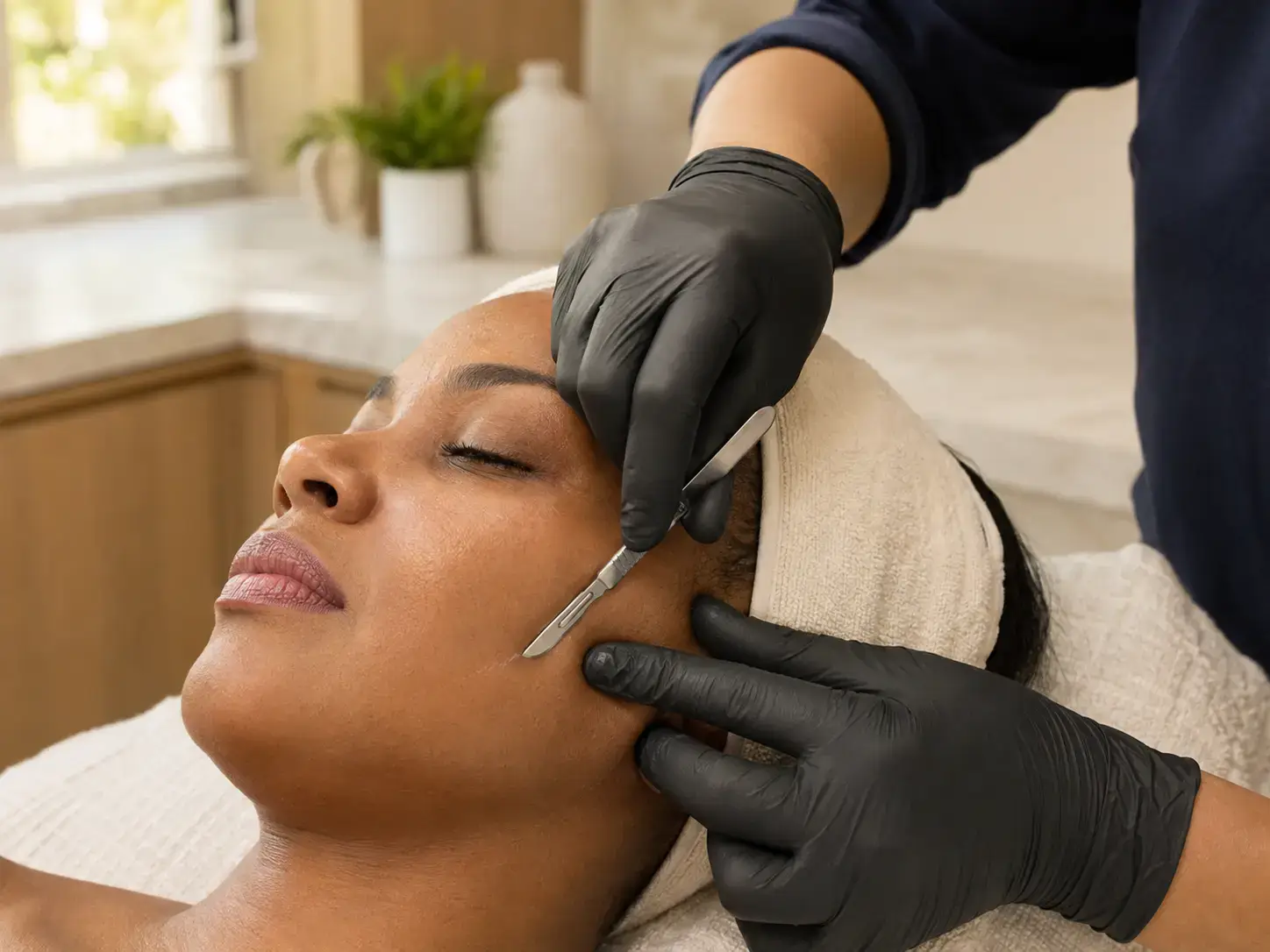
Dermaplaning is a surface treatment that takes around forty minutes. A sterile blade removes the layer of dead cells and fine vellus hair sitting on the surface of the skin, which can leave the skin looking brighter and feeling smoother, and can help make-up sit more evenly. Nothing is injected. Most patients have no visible downtime, though temporary redness or sensitivity may occur, and how much difference is noticeable varies from patient to patient.
Medically reviewed by Dr. Rajeev Bangalee, MBBCh · Star Aesthetic Centre, Durban North
At a Glance
- InvestmentR 800 (face)
- Duration30–45 minutes
- DowntimeUsually none — most patients return to normal activity the same day
What is Dermaplaning Treatment?
Dermaplaning is a manual physical exfoliation performed with a sterile surgical blade held at a shallow angle against taut skin. In a series of short, controlled strokes it removes two things at once: the stratum corneum — the layer of dead cells on the skin's surface — and the vellus hair, the fine soft down commonly called peach fuzz.
Removing that surface layer has three immediate effects. The skin reflects light evenly instead of scattering it, so it looks brighter. Make-up sits flat rather than catching on texture and fine hair. And topical skincare penetrates far more effectively, because the barrier of dead cells that was blocking it is gone — which is why a serum applied straight after dermaplaning does more than the same serum applied the day before.
Two persistent myths are worth dispensing with. Vellus hair does not grow back thicker or darker. It is not terminal hair, its follicle is unchanged by cutting, and it regrows exactly as it was — the sensation of stubble that some patients report is simply the blunt cut end of an existing hair, not a new coarser one. And dermaplaning is not shaving: it uses a different blade, a different angle, and its primary purpose is exfoliation, with hair removal as a by-product.
It is not suitable for everyone. Active inflammatory or cystic acne, active cold sores, open lesions or an inflamed skin condition in the treatment area all rule it out until resolved, because drawing a blade across inflamed skin risks spreading infection and worsening the condition.
How it Works
Skin Assessment
Double Cleanse
Preparation
The Dermaplaning Pass
Active Application
SPF & Aftercare
Pricing
Dermaplaning
| Face | R 800 |
| Added to another skin treatment | R 600 |
Expected Results & Timeline
Immediately: Visibly smoother, brighter skin with a noticeable improvement in light reflection, and no peach fuzz. Make-up applied afterwards sits noticeably flatter. Days 1–7: Skincare products work more effectively as the surface barrier of dead cells has been removed. Weeks 3–4: Dead cell build-up and vellus hair gradually return to their previous state — the hair regrows exactly as it was, not thicker or darker. Recommended frequency: every 4 weeks, aligned with the skin's natural cell turnover cycle. Dermaplaning is a surface treatment: it improves texture, brightness and product absorption, but it does not treat pigmentation, wrinkles or acne scarring, which require Dermapen microneedling, peels or other modalities.
Downtime & Aftercare:
There is usually no visible downtime, though some patients have mild redness for an hour or two afterwards. The skin is temporarily more sensitive to UV, so broad-spectrum SPF 50 is essential for the following week — non-negotiable in Durban sun. Avoid retinoids, exfoliating acids and scrubs for 3–5 days, and skip saunas, steam rooms and swimming pools for 24 hours. Make-up can be applied immediately, and typically sits better than it ever has.
Frequently Asked Questions
Will my hair grow back thicker or darker?
No. This is the most common myth about dermaplaning and it is simply not true. Vellus hair is not terminal hair, and cutting it does not alter the follicle, its diameter or its pigment. It regrows exactly as it was, over 3–4 weeks. What some patients notice is the blunt cut end of the existing hair feeling slightly coarse — that is the same hair, not a new one.
Does dermaplaning hurt?
No. No anaesthetic is needed. Most patients describe a light scraping or brushing sensation and find it relaxing. Because the blade removes only dead surface cells and fine hair, there is nothing to cause pain.
Is dermaplaning safe during pregnancy?
Yes — and it is one of the few clinic treatments that remains available throughout pregnancy and breastfeeding, when chemical peels, injectables and most active ingredients are contraindicated. Nothing is absorbed and nothing is injected. Tell your practitioner that you are pregnant so post-treatment products are chosen appropriately.
Can I have dermaplaning if I have acne?
Not while it is active. Active inflammatory or cystic acne, pustules, open lesions or an active cold sore rule dermaplaning out in the affected area — a blade drawn across inflamed skin can spread bacteria and worsen the breakout. Once acne is controlled, dermaplaning can be very useful for the residual texture. Dr. Bangalee will assess and advise the right sequence.
How often should I have it done?
Every four weeks suits most patients, matching the skin's natural cell turnover cycle. More frequent treatment does not improve the result and risks over-exfoliating and compromising the skin barrier.
Is this just shaving my face?
No. Dermaplaning uses a sterile surgical blade held at a specific shallow angle on dry, taut skin, and its purpose is to remove the stratum corneum — the dead cell layer. Hair removal is a by-product, not the goal. A razor is designed to cut hair at the skin surface and does not exfoliate in the same controlled way. The technique, the blade and the intent are all different.
Can dermaplaning be combined with other treatments?
Yes, and it works well as a preparatory step. It is commonly performed immediately before a chemical peel or a hydrating mask, because removing the dead cell layer allows the following treatment to penetrate evenly. Dr. Bangalee will advise on appropriate combinations for your skin — some pairings are excellent, others over-exfoliate.
Will it help with my pigmentation or acne scarring?
Only superficially. Dermaplaning improves texture, brightness and product absorption, which can make pigmentation look slightly less obvious, but it works at the surface and does not reach the depth where pigmentation or scarring actually sits. Those concerns need Dermapen microneedling, chemical peels or targeted pigmentation treatment.
What must I avoid afterwards?
Avoid retinoids, exfoliating acids and physical scrubs for 3–5 days, and saunas, steam rooms and swimming pools for 24 hours. Most importantly, wear broad-spectrum SPF 50 daily — freshly exfoliated skin is more UV-sensitive, and in Durban sun that is not a theoretical risk.
Is it safe for darker skin tones?
Yes. Because dermaplaning is purely physical exfoliation with no heat, light or chemical agent, it carries a low risk of post-inflammatory hyperpigmentation and is generally suitable across Fitzpatrick skin types — a real advantage for patients who have had to be cautious with lasers and stronger peels.
Who Is This For?
- ✓Patients wanting immediately smoother skin with zero recovery time — the treatment of choice before an event, a shoot or a special occasion.
- ✓Those bothered by fine facial hair (peach fuzz) that catches light or causes make-up to cling and look textured.
- ✓Anyone whose make-up sits poorly — foundation that clings to dry patches or looks powdery no matter the product.
- ✓Patients with dull, flaky or congested-feeling skin caused by a build-up of dead surface cells.
- ✓Those who want better results from their skincare — active ingredients penetrate substantially better once the dead layer is removed.
- ✓Pregnant and breastfeeding patients, for whom most chemical and injectable treatments are contraindicated. Dermaplaning is one of the few options that may be considered during pregnancy, subject to assessment.

Assessed by Dr. Rajeev Bangalee
MBBCh · Dermaplaning Treatment is assessed and planned by Dr. Bangalee, and may be performed by a trained assistant under his clinic protocols.
Star Aesthetic
Star Light Rewards
Earn Star Lights on every purchase — 5% back
5% back in Star Lights on all treatments & products
1 Star Light = R1 of rewards value
Redeemable against any future visit or purchase
No sign-up needed — created on your first visit
Star Aesthetic
Gift Vouchers
The perfect gift for someone you love
Delivered by email · Valid 3 years · Redeemable on all treatments & products
Send a Gift Voucher →SKIN & HAIR
Something for the week of the event, not the month before.
Dermaplaning can leave the skin looking smoother and brighter on the day, and most patients have no visible downtime. It is also one of the few treatments that may be used during pregnancy, subject to assessment. Book an assessment to confirm your skin is suitable.
Patient Reviews
Be the first to review Dermaplaning Treatment
No one has reviewed this treatment yet. If you've been treated here, your experience is the one that helps the next person decide.
This space is waiting for you
Share your experience to help other patients make an informed decision.
This space is waiting for you
Share your experience to help other patients make an informed decision.
This space is waiting for you
Share your experience to help other patients make an informed decision.
Medical disclaimer: Treatment results vary between individuals. All procedures are performed by Dr. Rajeev Bangalee (MBBCh), a registered medical practitioner. Information on this page is for educational purposes and does not replace a personal consultation.